The DUPR Pickleball
Rating Guide
DUPR rates every pickleball player on the same 2.00–8.00 scale, using real match results. Here's what every level actually means, and how to get rated yourself.
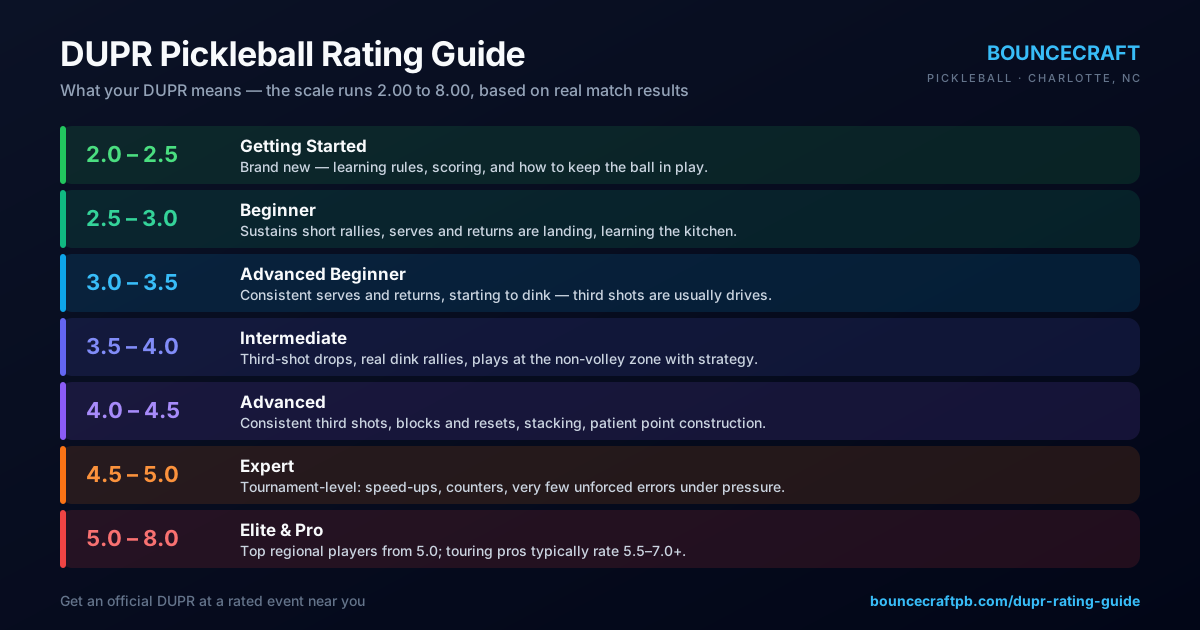
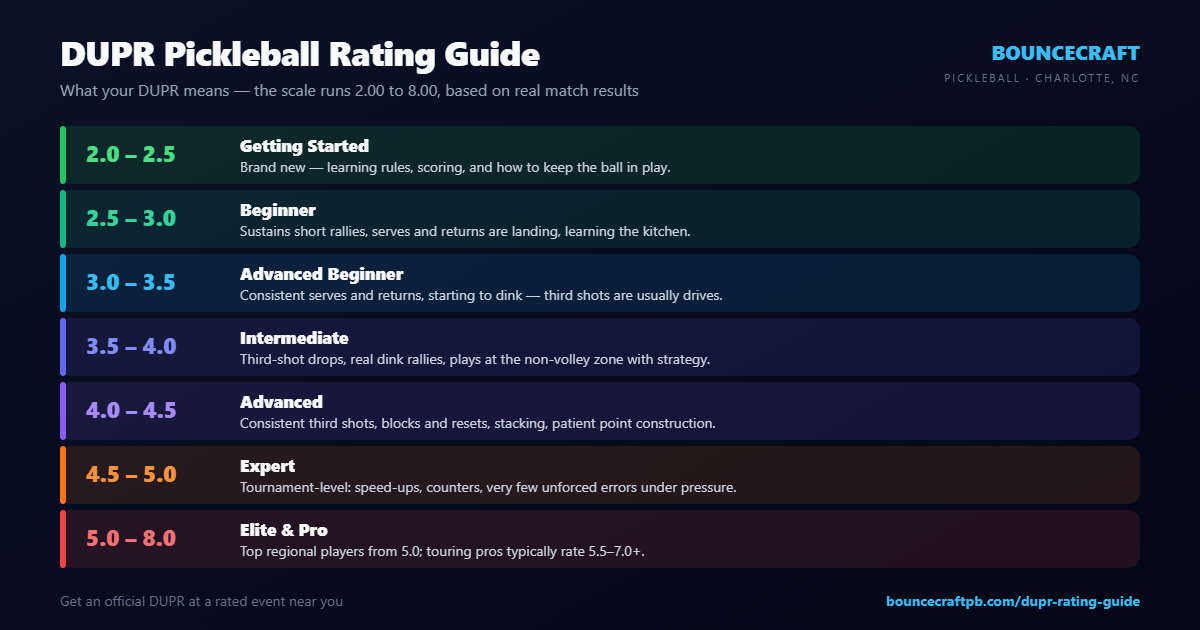
Every DUPR level, explained
| DUPR | Level | What it looks like on court |
|---|---|---|
| 2.0 – 2.5 | Getting Started | Brand new to the sport. Learning the rules, scoring, and serve. Rallies are short, and the kitchen (non-volley zone) is still a mystery. |
| 2.5 – 3.0 | Beginner | Can sustain short rallies with players of similar ability. Serves and returns land most of the time. Knows the rules, including kitchen basics, but consistency comes and goes. |
| 3.0 – 3.5 | Advanced Beginner | Serves and returns are reliable. Starting to dink on purpose rather than by accident, but third shots are still mostly drives. Court positioning is improving. |
| 3.5 – 4.0 | Intermediate | The biggest club-player bracket. Hits third-shot drops, sustains real dink rallies, moves to the non-volley zone with a plan, and starts using strategy, not just reactions. |
| 4.0 – 4.5 | Advanced | Consistent third shots under pressure, blocks and resets against bangers, understands stacking, and constructs points patiently. Few unforced errors. |
| 4.5 – 5.0 | Expert | Competitive tournament level. Initiates speed-ups at the right moments, counters attacks, and controls tempo. Weaknesses are hard to find and exploit. |
| 5.0 – 8.0 | Elite & Pro | Top regional players start around 5.0. Touring professionals typically rate 5.5–7.0+, with the very best players in the world approaching the top of the scale. |
How DUPR actually works
Unlike self-assessed skill ratings, DUPR is earned on the court. Every DUPR-rated match you play (league night, tournament, or rated open play) feeds the algorithm. It looks at who you played, their ratings, and the score, then adjusts your rating after every match.
A few things worth knowing: singles and doubles are rated separately; beating higher-rated opponents moves you up faster; and your rating gets more stable (and more accurate) the more rated matches you log. That's why the fastest way to an accurate rating is simply playing more rated games.
Not sure where you'd land? Take our free 2-minute pickleball skill quiz for an estimate, then confirm it on court.
How to get a DUPR rating in Charlotte
Create a free DUPR profile, then play DUPR-rated events. Every Bouncecraft DUPR match night submits results directly to DUPR, most players have an established rating within a few sessions.
Find a DUPR-rated event →Want a full season of rated play? Join the Fall League, DUPR reporting included (optional per team).